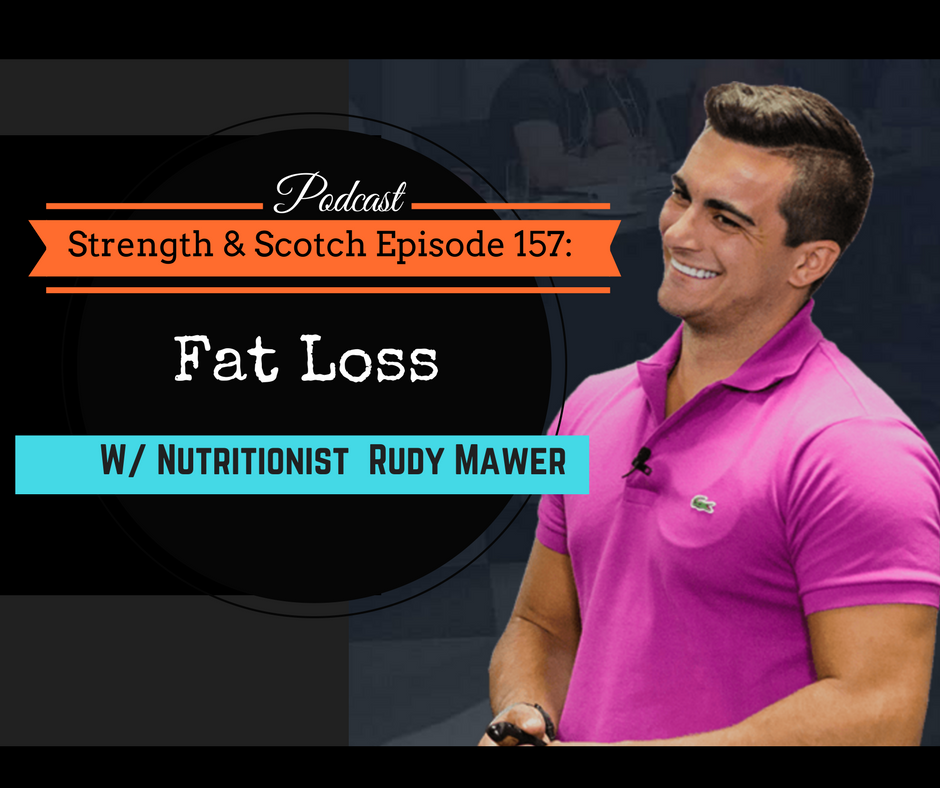
SS 157 – Fat Loss With Celebrity / Sports Nutritionist Rudy Mawer
Episode 157 Show Notes

Grant and Heavey are joined by celebrity/sports nutritionist Rudy Mawer, the man behind RudyMawer.com. Rudy did his master’s in Exercise and Nutrition Science. Although primarily known as a female fat loss expert, his impressive portfolio of clients range from normal, everyday people to professional athletes and celebrities.
Today, he tackles issues around fat loss in regards to fad or trendy diets. Do they work? What diet is the best? Find out more from the expert himself!
[02:55] NBA Players Going Vegan?
Grant dishes out another interesting Bleacher Report articled called, The Secret (but Healthy!) Diet Powering Kyrie and the NBA. It basically revealed that Kyrie Irving, along with a whole group of NBA players, have gone vegan over the past couple of years. Their reason? They wanted to lose weight so they can play the game faster.
[05:40] Rudy Working with NBA Athletes
Rudy admits he has consulted with NBA players. Heavey says most of these athletes have junk diets. A lot of them sort of lean on their “gift” and don’t necessarily optimize their lifestyle, training, or nutrition the way they should.
With the athletes Rudy has worked with, their diet usually comprises of mostly meat and animal products, except for religious or personal reasons. Interestingly enough, Rudy’s parents were vegetarian and he was brought up that way. However, Rudy has seen the benefits of eating meat and actually eats meat now. What he does with his athletes usually involves incorporating lots of complex and healthy carbohydrates because they train a lot – lots of protein like meat and fish as well as fruits, vegetables, and healthy fats. With that said, Rudy doesn’t recommend going vegan to NBA players or athletes in general.
[09:15] Vegan Doesn’t Necessarily Mean Healthy
Heavey says there are are genetic outliers. You’d see some professional bodybuilders that maintain a vegan diet, so there are people that can make it work.
A lot of people say they lost weight by going vegan. That’s not surprising when switching from a crappy diet. Eating fruits and vegetables which were missing in your diet previously and now adding in these nutrient dense foods will obviously have a significant impact.
In fact, a lot of people that eat a vegan diet are eating junk like paleo brownies. It’s not just vegans who do this but really everybody.
Grant adds vegan doesn’t necessarily mean healthy. You don’t eat meat but you can eat sugar products, which isn’t necessarily good for you. Therefore, if they think they’re being healthier by going vegan, they could be missing the bigger picture.
[10:35] The Rise of the Vegans
In this same article, Grant mentions a statistic that showed veganism rose in the UK by 350% over the past ten years.
Rudy explains how, just like a fad diet, people want to be a part of a “group.” They want to be Paleo or Macros. Now they want to be Keto’s.
Heavey adds there’s always that cycle of nutrition where one new, shiny diet is jumping out into the limelight. Not limited to the vegan diet, anytime you have a diet that says this small group of foods is good and all of these other foods are off-limits is not a successful approach. You’re eliminating a huge set of foods that have a different set of nutrients you’ll be missing out on by focusing on one core group of foods.
[12:44] Does Less Weight Equal Better Performance?
Again, Grant mentions athletes are doing this to lose weight so they can play faster. Even Magic Johnson cracked down on his team, pushing them to losing weight too. He wants to bring the body fat threshold down below 10% for the team.
Ten years ago the fastest team in the NBA was the 76ers who had 95 possessions per 48 minutes. This year, the slowest team is having 98 possessions. This present-day slow team would have been faster than the fastest team ten years ago. Grant points out that coming from two well-educated trainers (Heavey and Rudy) that this is not the way to do it.
[14:55] Is Vegan Diet Recommended?
The rule Rudy sets with his clients is that the best diet is the one you could stick to within reason. If someone wants to stick with a vegan diet, he makes sure to help his clients as much as he can but there’s still going to be nutrient deficiencies. He recommends something you can stick to and lose weight with as well as obtain health benefits like losing body fat. This is a long term successful approach instead of trying diet after diet and eventually rebounding back to pizza and donuts. It’s very common these days that people do diets they don’t like and attempt these superior diets. However, Rudy stresses that sustainability is key.
[16:26] The Constant Search for that Superior Diet
Heavey points out the reason for these diet cycles is that everybody is chasing this “ideal diet.” They try something and it doesn’t work. Then, they hear about this new diet and think it must be the diet that actually works. They’re always chasing this one superior diet and not really paying attention to what are your personal inclinations. What do you think your lifestyle is capable of supporting?
Heavey likes Rudy’s stance where he’s saying there are some circumstances that may not be ideally necessary from a nutritional perspective but it may be the best choice for somebody because that’s the thing they could stick to.
Rudy adds it could also be that magic of elimination that since you’re on a particular diet like restricting things like processed food so you’re eating healthier. The variable you can control is protein because it has been shown to have an effect on body composition.
Just like the NBA athletes, if protein is low due to a vegan diet, they will lose weight quicker because they can lose about 50% muscle mass. This is catastrophic compared to a high protein diet which is shown in a lot of studies to retain a lot more muscle mass.
[20:12] The Principle Behind Time-Limited Programs
Having done this for a decade now, Rudy learned that as much as you don’t know what’s ideal, sustainable, and healthy for the client or the individual, people want quick results. They want to know that in X amount of time they were able to do this. You have to make the decision as to whether you’re going to teach the best way or you’re going to teach the way most people can keep to, stick to, and be interested in and then do your best to tailor yourself around that.
The reason they’re doing these time-limited programs is people want to know that in 30 days or 4 weeks or however long, they can achieve results. It’s more from the mindset or psychology where people can set goals and then as trainers, do their best to help them achieve the best results within that time frame. All while, getting them to develop sustainable habits that they can maintain long term.
Heavey recognizes where Rudy is getting at here, which is finding that balance where you can give them just enough good stuff but also give them a little bit of something that’s going to keep them motivated and going.
[23:45] Short-Term Fat Loss versus Long-Term Fat Loss
Heavey throws this valid question at Rudy as to how he does it with clients, specifically celebrities, who may want to achieve short term weight loss that may not be necessarily sustainable. Rudy explains that it’s not ideal to lose 20 pounds in five weeks but if you got paid a million dollars, would you do that?
He would actually argue a lot with celebrities that have a harder time than others. It’s about getting that balance between being rapid and sustainable because it’s pointless if you get a 30- or 60-day result but then don’t have a clue about how to sustain it. Rudy describes this is where the industry is at right now. There’s so much focus on the short-term without any focus on what to do in the long term.
This is where they’re trying to bridge that gap. Many clients try to achieve short term results. They go against the 7-day juice diet and the weight loss pills. They’re battling against this as coaches so they’re able to provide long-term, sustainable routines. They have to balance that with getting someone quick results to keep them happy but also teach them how to sustain it over the long term.
[25:47] Body Part Specializations
The idea here, as Rudy describes it, is to tweak the training volume and frequency, how many times they train that bodypart. Like anything in life, the more you do something, the better you get at it. People in fitness seem to like training specific body parts on specific days. The thought process is if you want to develop as specific part, you do work out that part more times in a week.
[27:05] Intermittent Fasting and Macro Programs: Which One Is Better?
Aside from intermittent fasting and macro plans on Rudy’s website, he also offers other things like the vegan plan, 90-day bikini plan, vegetarian plan, etc. As what he said, it’s not necessarily the best diets, but he wants to give people options. Within those options, he wants to give them a solid diet plan. With that said, you can combine macros and intermittent fasting very well.
Intermittent fasting involves restricting food during a set time period and eat during a certain time frame. The way some people go wrong with intermittent fasting is they overeat during that feeding window.
What is actually recommend is to track macros because there’s no magic by skipping food for a certain period. The magic is in reducing calories. By tracking the macros and calories, you can make sure that you’re still not over-consuming in that feed window because you’re so hungry.
[28:35] What Do These Men Eat?
Rudy is not following a specific type of diet but a mix. He describes not being tied to anything. Sometimes he uses intermittent fasting and eats more protein in the day. He eats more protein since he trains twice a day.
Heavey has a very protein-heavy diet. So it’s basically protein and veggies every meal. And then he adds in some white rice or potatoes for calories. At 6″1″ he went from 140 pounds in high school and up to 185-190 now, so he does everything he can to hold onto it.
[29:55] The Concept Behind Female Fat Loss
Being a female fat loss expert, he went down this route since he understands the industry is created by men for men. There’s a big gap where people come to him along with a lot of misinformation
For the most part, a lot of the same principles apply. You can eat healthy, whole foods and focus on higher protein. There can be a need for women to learn how to tailor that calorie and food intake. A lot of recommendations on portion size, calories, and meal size are more tailored to men. Especially for female fat loss, metabolism is a different between both genders. Women have slower metabolisms as opposed to what most people think.
[32:05] Women and Disordered Eating
Rudy explains that for the most part, a lot of women have slower metabolisms because they’ve done five to eight diets. Much of the research coming out in the last five years says that every time you diet, your metabolic rate takes a hit. Your hormones take a hit. Your metabolism drops. It often doesn’t fully recover and your hunger hormones are higher.
Focus on the foundation. Spend some time working on the foundation and improving your metabolism, creating a healthy lifestyle, and going from there.
[33:50] The Battle of the Sexes: Fat Loss Difference Between Men and Women
Without trying to generalize too much, Rudy illustrates how men can dive in and can go without diets and have bigger metabolic rate and calorie expenditures. Therefore, they have this bigger window per day to drop calories.
A woman aspiring 1500 calories to maintain weight doesn’t have a bigger window. If she wants to drop it by 500 calories, she has taken a third off the daily intake. Whereas a guy that is 2500 calories who drops 500 has only taken off 20%. Seeing the differences in nutritional value, a guy is going to be in a much better position because he’s only dropping 20% of his intake out even if it’s creating the same caloric deficit.
[34:45] Their Website Photos Don’t Lie and Some Results They’ve Seen
Just in case you’re wondering (like Grant is), the testimonial photos seen on RudyMawr.com are true and not edited.
Rudy describes a lot of people coming in who might only lose five or ten pounds during the 90 days but their bodies have totally changed. The actual scale weight might not change much, but there are changes in their circumferences around their waist or legs. Some people may look totally different but the average weight loss is 15-20 pounds. They’ve also had people losing up to 40-50 pounds. These are the people who usually weigh around 200 to 250 pounds.
In seeing these changes, there’s a lot that goes into it according to Rudy. In terms of the exercise, they change the way women look at it. They go from doing cardio or fitness classes for instance, to bodybuilding-style workouts such as resistance training, drops sets, super sets, circuit-based and HIIT trainings. They use a lot of advanced training techniques. They then clean up the diet and focus on high protein. In the 90-day program specifically, they talk about carb cycling a lot since a lot of women want to go low carb. But then again, they want to stress the sustainability thing.
[38:55] How the Carb Cycle Works
With carb cycling, you get some benefits from low carb, but have high carb days as well so there is overall balance. You see what works for you and your body. You see where you’re getting better energy and when you feel better in general. After that, you can tailor it more if you want lower carb days or higher carb days.
There are some physiological benefits within a day window. There’s also research around the training window. Like in postworkout, they can support recovery and reduce cortisol levels and increase sleep at night. There are smaller physiological benefits with carb cycle.
[40:45] Metrics for Seeing Progress: Look Beyond the Scale!
Again, Rudy doesn’t rely on seeing progress on the scale. They talk about it from Day 1 when their clients download it and join. In the manual, they get a table where they have to check in every two weeks like a coach would. They’d take measurements and photos. They’re being encouraged to look beyond the scale. They’re showing measurements and photos to keep themselves accountable. They are taught to see results even if the scales don’t move.
Going back to the basics, Rudy explains that muscle and fat weigh differently. They look differently. Now, with over 60,000 members in their Facebook group, you can see before and after photos of them being posted. You will see they only lost five pounds but they look like they’ve lost 20 pounds.
Heavey adds there’s a weird psychological thing that happens when taking pictures to see results. People tend to work harder because they want their picture to be better.
Another thing Rudy points out is that photos can be a big motivator. Women have these menstrual cycle changes so they retain a lot of water so measurements on the scale can be highly inaccurate for that reason alone. Even if someone is making progress but if they take measurements at a different time in the month, Rudy doesn’t want to demotivate them when they’re making great progress but they’re holding an extra five pounds of water weight.
[44:15] The Hardest People to Work With
Rudy has a broad spectrum of clients having worked with average Joes, models, athletes, and celebrities. For him. the most challenging to work with are the more ego-driven people which they do get with athletes sometimes, especially when he’s working with them as a team. They may not put in the practice since they’re naturally gifted. He does work with tough day-to-day people as well. They want to achieve their goals but don’t really understand how hard it is to actually lose weight and change their lifestyle. They’re not really that motivated.
Ultimately, it comes down to motivation and how much the client wants to achieve their goal.
[46:30] Rudy’s Recommendations
Rudy recommends to focus on eating high protein every meal. Your best sources of meat are fish and eggs. What’s more actionable and easy to implement in your lifestyle and nutrition change. Exercise as much as you can. Get a mix of exercise that you can sustain. Also get a mix of strength training, cardio and HIIT training since they will have different benefits for you.
Lastly, monitor food intake. Ultimately, it doesn’t matter how great your diet is or what diet you’re on, if your calorie intake is still too high, you won’t lose weight. Even if you’re doing a ketogenic, low carb, or vegan, if you’re eating too many calories everyday, you’re not going to lose weight.
Monitor calories in some way by either counting your calories or monitoring portion size. Whichever way you choose, you need to be certain that you’re consuming less than you’re burning.
Links:
Rudy Mawer Facebook group
The Secret (but Healthy!) Diet Powering Kyrie and the NBA

Check out the gear page for everything Strength & Scotch! You’ll find a listing of all the supplements and other programs we’ve discussed on the show as well as our killer t-shirts!